
Wales |
Wales is one of the countries that make up the larger entity of the United Kingdom (along with Northern Ireland, England and Scotland). It is situated on the west side of England and makes up less than a tenth of the entire United Kingdom. In fact, Wales is only 256 kilometres long and 96 kilometres wide. There are approximately three million people currently occupying this country.
The ancient history of Wales began when the Celtic tribes started their mass movement from Central Europe in 1000 BCE (Before our Common Era). These ones spoke a language that gradually evolved into the modern language of Welsh. Between this time and the time in which the Roman Empire gained control, there is not much known. Rome occupied Wales in 48 CE (Common Era), and this is when the official recorded history of the country began. In 550, the Germans (Saxons) again made an advance to occupy Wales, battling with the British for territory. In 1066, the Normans invaded England. However, due to the fact that Wales maintained its strong resistance to this invasion, the Welsh began to grow in their confidence and political sway. Still, it was only centuries later, in around 1400, that Owain Glyndŵr initiated the rebellion against King Henry IV in an effort to establish Wales as an independent entity. It took just four years for him to crown himself the Prince of Wales. When Henry Tudor became the King of England in 1485, he integrated much of the Welsh nobility into the English culture. In 1536, Wales and England were politically united under the English Law. In 1911, Prince Edward was made the Prince of Wales, awaiting his crowning as King Edward VII. In 1955, Cardiff was declared the official capital of Wales. 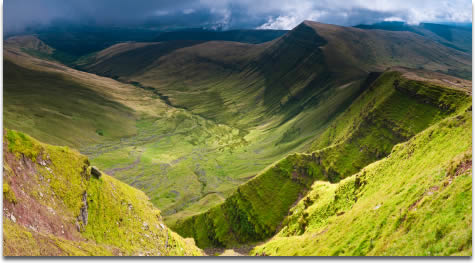 Storm clouds and sunlight illuminating the vibrant green landscape and steep mountain ridges of the Brecon Beacons National Park, Wales, UK.
Because of its ancient and complex history, Wales is now a destination of rich cultural and historical heritage. This continues to add a charming flavour to the country and lure visitors from all over the world, who want to immerse themselves in its fascinating legacy and enjoy its spectacular vistas. Wales is not a major commercial or economic epicentre. This is mainly due to its relatively small size and population as well as its large proportion of land unsuitable for crop farming. For these reasons, tourism plays an integral role in the maintenance of an optimal economy. For more information, please view: http://www.visitwales.com/ |